As noted by AppleInsider, the U.S. Patent and Trademark Office today published three Apple patent applications related to the company's Lightning connector introduced on its iOS devices late last year.
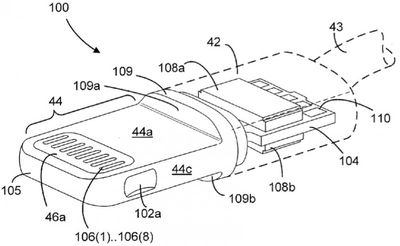
Perspective view of Lightning connector
The first application describes the hardware itself, while two nearly identical applications outline the adaptive technology used to assign pin functions. The only difference between the latter two applications appears to relate to one describing implementation on an electronic device while the other addresses its use on an accessory.
The present invention generally relates to connectors for connecting two devices. Specifically, certain embodiments of the present invention relate to reversible connectors with configurable contacts. [...]
Embodiments of the present invention provide techniques for dynamically configuring contacts of a host-side connector that is associated with a host system. In one embodiment of the present invention, a contact in the host-side connector is capable of being assigned one of several functions. The function to be assigned to the contact (and other contacts in the connector) may depend on the accessory coupled to the host system and the signals provided/used by the accessory. For example, when an audio only accessory is coupled to the host system, at least one of the contacts on the host-side connector can be configured to carry audio data.
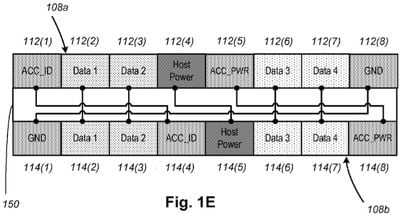
Example pin-out diagram of Lightning connector
As part of the hardware-focused patent, Apple shares several examples of implementations for the Lightning connector, including the Lightning Digital AV adapter, Lightning to SD Card Camera Reader, and even an as yet unreleased Lightning dock of similar design to the company's iPad dock for the first-generation iPad with its 30-pin connector standard.
Apple's three patent applications published today were filed in November and December of last year, but are continuations of similar applications filed on September 7, 2012, five days before the company officially announced the standard as part of the iPhone 5 introduction. The patent applications can, however, be traced back even further to several provisional patent applications filed by Apple in November 2011.
Tuesday February 10, 2026 4:27 pm PST by Juli Clover
Apple is planning to launch new MacBook Pro models as soon as early March, but if you can, this is one generation you should skip because there's something much better in the works.
We're waiting on 14-inch and 16-inch MacBook Pro models with M5 Pro and M5 Max chips, with few changes other than the processor upgrade. There won't be any tweaks to the design or the display, but later this...
Wednesday February 11, 2026 10:07 am PST by Juli Clover
Apple today released iOS 26.3 and iPadOS 26.3, the latest updates to the iOS 26 and iPadOS 26 operating systems that came out in September. The new software comes almost two months after Apple released iOS 26.2 and iPadOS 26.2.
The new software can be downloaded on eligible iPhones and iPads over-the-air by going to Settings > General > Software Update.
According to Apple's release notes, ...
Tuesday February 10, 2026 6:33 am PST by Joe Rossignol
It has been a slow start to 2026 for Apple product launches, with only a new AirTag and a special Apple Watch band released so far. We are still waiting for MacBook Pro models with M5 Pro and M5 Max chips, the iPhone 17e, a lower-cost MacBook with an iPhone chip, long-rumored updates to the Apple TV and HomePod mini, and much more.
Apple is expected to release/update the following products...
Tuesday February 10, 2026 1:51 pm PST by Joe Rossignol
Apple plans to announce the iPhone 17e on Thursday, February 19, according to Macwelt, the German equivalent of Macworld.
The report said the iPhone 17e will be announced in a press release on the Apple Newsroom website, so do not expect an event for this device specifically.
The iPhone 17e will be a spec-bumped successor to the iPhone 16e. Rumors claim the device will have four key...
Apple acquired Canadian graph database company Kuzu last year, it has emerged.
The acquisition, spotted by AppleInsider, was completed in October 2025 for an undisclosed sum. The company's website was subsequently taken down and its Github repository was archived, as is commonplace for Apple acquisitions.
Kuzu was "an embedded graph database built for query speed, scalability, and easy of ...
I'm confused as to why the connector is so complex. The plug has eight pins on either side, but the jack only has eight pins on a single side. It seems that if the function of the pins on the plug were identical on each side, everything should work just fine. Even though the old dock connector had 30 pins (most of which were never used), I'm not sure what flexibility Apple is gaining by having adaptive Lightning connectors. I would think eight non-adaptive connectors would be able to carry all the needed power and data.
Because this is what allows the connector to work no matter which side you plug in. Probably my favorite feature of the Lighting connector. Nice little innovation IMO.
I see that, for a lot of people, Apple continues to do nothing right. Now that people are bored of complaining about Antennagate, I guess this is the next best thing to whine about.
Yeah a connector change is a bit painful at first, and some people are still waiting for more compatible accessories. But Apple has always "skated to where the puck is going" instead of "where the puck is" and this is no exception. Other than being a robust, tiny, easy to use little cable, it's highly adaptable to future needs. For those who see this new connector as a big complaint, may I suggest you skip a generation and hang on to your 30 pin devices a while longer until accessory makers catch up and prices drop.
I've had the iPhone 5 since it came out, and I like the new cable. It's not a big deal or anything, but it's one more coat of polish on a great product line, and I expect the change to pay more dividends down the road.